
If you're a Mac user, you probably know that 3D rendering on Mac can be a struggle.
Most 3D rendering software is not compatible with Apple computers, and when it does, it doesn't run as smoothly as it does on Windows machines.
Why is that?
Well, there are many reasons for that:
That's why there are fewer rendering programs for Mac than for Windows.
Does it mean that you should swap your Apple computer for a Windows machine?
Not necessarily.
There are still plenty of tools you can use to render architectural and interior designs on your Mac.
To save you some hassle, we've researched the compatibility of some of the top renderers on the market to help you make an informed choice.
Let's have a look.
Compatible? Yes
Supported chips: M1, M2, M3, M4
System: all
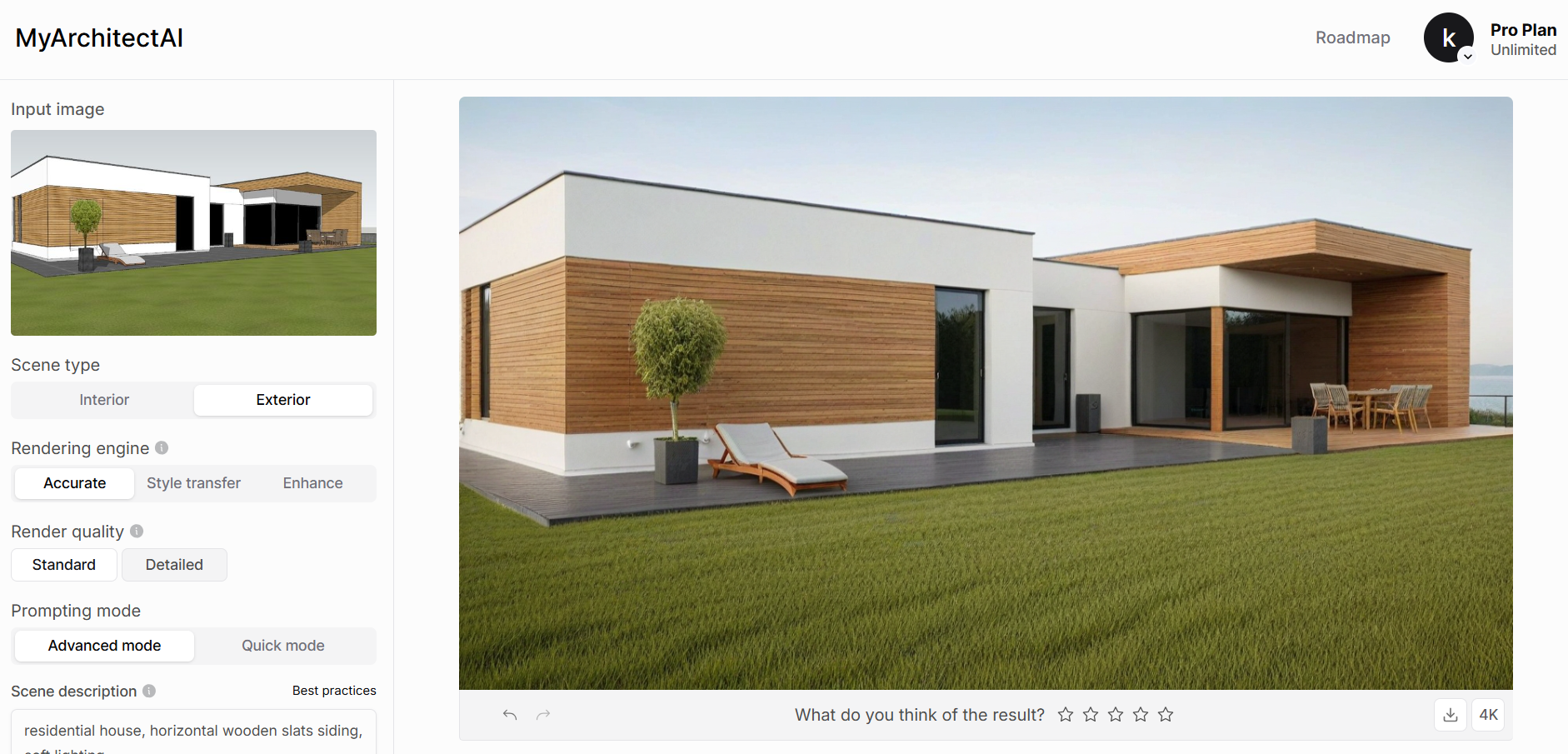
MyArchitectAI is a cloud-based Mac rendering software that runs directly in your browser.
You can access it from any device (Mac, iPad, or even an iPhone) - just log in and start creating. There's no need to download or install anything.
MyArchitectAI is a great fit for busy architects, interior designers, and makers who can't afford to spend hours on every render. Thanks to its AI-powered engine, it lets you visualize any scene in just 10 seconds, without sacrificing quality.
Here’s how to render your designs on a Mac using MyArchitectAI:
2. Upload your design (CAD export or linework).
.jpg)
3. Pick a rendering engine. "Accurate" to add realism while keeping everything else unchanged, "style transfer" to create new concept based on your line drawings, or "enhance" to add a final polish and increase the resolution of existing renders.
.jpg)
4. Press the "generate" button.
5. Your rendering will be ready in about 10 seconds.
%20(1).jpg)
6. Lastly, edit or enhance the image if needed by clicking the buttons below your render.
Pricing: 10 renders a month are free. Then, $29/month gets you unlimited renders.
Compatible? No
D5 Render is Windows-only as of 2026. There's no native Mac build, and none announced for near-term release. D5 is running a public Mac user waitlist, though, which signals a native version is on the long-term roadmap without a committed date.
Mac architects who want D5 specifically have three paths:
For a full walkthrough of each workaround, the waitlist details, and native alternatives, see our D5 Render for Mac guide.
Compatible? No
Lumion doesn’t work on Mac computers, and its developer doesn’t plan on making it compatible anytime soon.
While you can download Lumion on your Mac and run it using Apple's Boot Camp software for Windows 10, it's not recommended (or supported) because it's buggy and doesn't use your Mac's hardware efficiently. Aside from that, your MacBook would need an Intel CPU (Apple's M1, M2, and M3 CPUs are not compatible).
Consider these Mac-compatible Lumion alternatives instead.
Compatible? Partially
Supported chips: M1, M2
System: macOS X 10.9 Mavericks or later

Best for: full customizability and pixel-perfect realism.
While you can install and run V-Ray on Mac computers, V-Ray GPU will only work using CPU processing.
You can still run distributed rendering between your Mac and Windows/Linux machines, with both using the CUDA engine - your Mac handling CPU tasks while the other machine uses its GPU. Just keep in mind this isn't the most efficient setup.
V-Ray is available for both SketchUp and Rhino on Mac computers.
Pricing: Starts at $85/month. Free 30-day trial available.
Compatible? Yes
Supported chips: M1, M2, M3
System: macOS Monterey 12.6 or later

Best for: quick and easy stills and animations with a decent level of control.
Enscape for Mac is fully compatible with:
Find more details on Enscape's system requirements for Mac in our guide.
Pricing: Starts at $85/month. Free 14-day trial available. More pricing details here.
Compatible? Yes
Supported chips: M1, M2, M3, M4
System: macOS Monterey 12.5 or later (Twinmotion can run on older macOS versions but they're not officially supported)

Best for: small studios looking for a versatile and user-friendly rendering workflow.
While you can render your designs using Twinmotion on Mac computers, there are certain limitations compared to Windows:
Pricing: Free for firms doing less than $1M in annual revenue. Above that level, it costs $445 per seat per year.
Compatible? Partially
Supported chips: M1, M2, M3, M4
System: macOS 11.7 Big Sur or newer

Best for: product and industrial designers who need the highest levels of realism.
Since 2022, KeyShot is available on Mac computers, offering full Apple silicon support.
Users with newer Macs with Apple silicon chips report 15% to 30% performance gains in rendering and usability.
The biggest downside though is that GPU rendering is not supported.
Pricing: $1,188/year. 14-day free trial available. Full pricing guide here.
Compatible? Yes
Supported chips: M1, M2, M3, M4
System: macOS 11 or newer

Best for: medium to large production studios and technical artists who need scriptable control for high-end 3D animations and VFX.
Maya is a great choice as Mac rendering software as it runs natively on macOS and its performance is stable across all Apple M-series chips.
Although relatively rare, some users have reported compatibility issues with certain plugins.
Pricing: $260/month or $2,085/year. 30-day free trial available.
Compatible? Yes
Supported chips: M1, M2
System: macOS 12 Monterey or newer

Best for: VFX, film production, and product design firms that need full control of the output and highest level of quality.
Octane Render works on Mac computers and supports both AMD and Apple GPUs. Octane X Network rendering is supported too.
Pricing: $24/month or $240/year.
Best for: motion graphics designers, advertising studios, and freelancers doing client work where deadlines matter more than budget.
Cinema 4D runs native on Apple Silicon. Maxon launched M1 support in 2021 and has kept up with each chip generation since. It includes Redshift (Maxon's production renderer) and Cinema 4D's built-in Standard and Physical renderers, all three running native on M-series with Metal acceleration.
For archviz work that leans toward motion graphics (animated walkthroughs, transitions, title sequences for client presentations), Cinema 4D is probably the most capable native Mac option. The Maxon One subscription bundles Cinema 4D with Redshift, ZBrush, and Red Giant, which often works out cheaper than buying those pieces separately.
Pricing: $109/month or $839/year. 14-day free trial available.
Best for: solo artists, indie game developers, freelance 3D generalists, students, small studios.
Blender is free and open-source, and it runs native on Apple Silicon with full Metal support. Cycles (Blender's path tracer) has shipped Metal GPU rendering since Blender 3.1, and performance on an M3 Max or M4 Max sits in the same league as RTX 4060-class Windows hardware.
For architects who don't need plugin integration with Revit or Archicad, and who are willing to climb Blender's learning curve, it's the strongest free option on Mac. Importing Revit or Archicad models means exporting to DWG or FBX first, but once the geometry is in Blender, you can render final stills and animations at no extra cost.
Pricing: 100% free (Blender is open-source)
Apple Silicon support isn't all-or-nothing. Some renderers ship native M-series builds with full Metal acceleration. Others still run under Rosetta 2 translation, which typically costs 20-30% performance. A few won't run on Mac at all without a Windows VM or cloud workaround.
The fully native tier, with Metal acceleration, covers Cinema 4D, Blender, KeyShot, Twinmotion, Octane X, Maya (since 2022), V-Ray for Maya, and MyArchitectAI (web-based, so it runs anywhere). These are the apps you'd actually buy an M-series Mac to run.
Enscape (as a SketchUp plugin on Mac) and Lumion's macOS beta run native but don't yet use the Apple GPU's full capability. They work, but an equivalent Windows setup will still render faster in 2026.
D5 Render, Revit, most V-Ray for Revit workflows, 3ds Max, and ArchiCAD with V-Ray don't have Mac builds at all. Running these on a Mac means a Windows VM (Parallels), Boot Camp on older Intel Macs, or renting a cloud GPU through Vagon or Paperspace. At that point, the rendering performance isn't really about your Mac anymore.
Rough performance tiers in 2026, benchmarked on GPU path-traced rendering in Cinema 4D Redshift or Blender Cycles:
So a $2,500 Windows workstation with an RTX 4090 still beats any current Mac on raw render speed, and the gap widens for CUDA-only renderers like V-Ray GPU or Octane on Windows. What Macs trade for is silent thermal design, battery portability, and not having to maintain a separate Windows box. If your deadline constraint is render time, a Windows build is still cheaper per hour of rendering.
Mac users have limited options compared to Windows users when it comes to 3D rendering software.
Some of the most popular programs such as V-Ray, D5 Render, and Lumion are not available for Mac, which can be frustrating for architects who prefer the Apple ecosystem.
These users need to either switch platforms or find alternative rendering tools that run on Mac.
So if you're already a Mac user, choose one of the compatible renderers we listed above.
However, if you're planning to buy a Mac primarily for 3D rendering, consider a Windows PC instead. Windows machines with Nvidia GPUs will give you better performance, more reliable rendering, and a wider range of CGI programs to choose from.
Most tools mentioned above are compatible with all major architectural CAD programs like SketchUp, Archicad, and Rhino. So depending on your needs, you may consider MyArchitectAI for speed and ease of use, Enscape for compatibility, and Twinmotion for animations.
While Apple silicon chips are very powerful, they're not a good choice for 3D rendering. The main reason for that is that most 3D rendering software is designed to work with NVIDIA's CUDA technology and RTX features, which are not available on Macs since Apple doesn't use NVIDIA GPUs.
Here are three great options you should consider:
1. Mac Studio with M2 Ultra (Best balance of power and value)
Features:
2. MacBook Pro 16-inch with M4 Max (Best Mac for portability)
Features:
3. Mac Pro with M2 Ultra (Best Mac for extendability)
Features:

.webp)